Home / Shop / Synedica NAD+ & B12 Kit
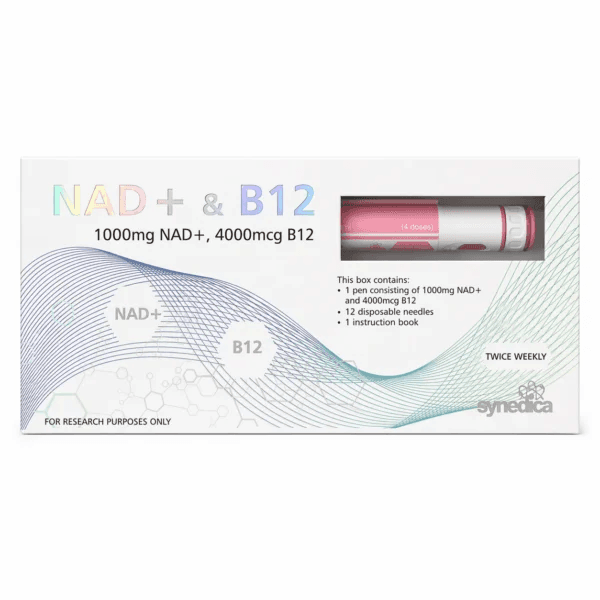
Synedica NAD+ & B12 Kit
The Synedica NAD+ & B12 Kit supplies nicotinamide adenine dinucleotide (NAD+, CAS 53-84-9) and vitamin B12 (cyanocobalamin, CAS 68-19-9), two coenzyme/cofactor molecules studied together in cellular energy metabolism and methylation research. Synedica UK offers this kit for sale strictly for laboratory and in-vitro research use, not as a licensed medicine, food supplement, or treatment.
£145.00 – £42500.00
Kits
Form: Injection Kit
Quantity
Form: Injection Kit
Storage & Handling
Storage (Lyophilized): Store at -20°C in a dry, desiccated environment. – After Reconstitution: Store reconstituted peptide at 2–8°C and use within 30 days. For long-term storage, aliquot and freeze at -20°C. Avoid repeated freeze-thaw cycles. – Reconstitution: Reconstitute in sterile bacteriostatic water or appropriate buffer depending on experimental needs.
â ï¸ This product is sold strictly for in vitro research and laboratory use only. It is not for human or veterinary use. By purchasing or using this product, the buyer agrees they have read, understood and accept the Terms & Conditions of Synedica UK. Terms & Conditions.
NAD+ is one of the most searched research compounds in the UK peptide and biochemical supply market, and listings for it are often thin: a purity percentage, a price, and little else. Researchers pairing it with vitamin B12 for coenzyme and methylation-pathway work usually want more — verified chemical identity, a clear account of what has actually been studied, and batch-specific testing rather than a marketing claim. This page sets out what the Synedica NAD+ & B12 Kit is, what current research says about each molecule, and how to verify what arrives before it goes anywhere near the bench.
What NAD+ and B12 Are
Nicotinamide adenine dinucleotide (NAD+) is a pyridine nucleotide that functions as a redox cofactor, carrying electrons between reactions in glycolysis, the citric acid cycle and oxidative phosphorylation. It also acts as a substrate — not just a cofactor — for NAD+-consuming enzymes including sirtuins, poly(ADP-ribose) polymerases (PARPs) and CD38, which link it to DNA repair, chromatin regulation and cellular stress signalling. It carries CAS number 53-84-9, molecular formula C21H27N7O14P2, and a molecular weight of approximately 663.4 g/mol.
Vitamin B12 is a cobalt-containing corrinoid vitamin studied as a cofactor for two enzymes: methionine synthase, which converts homocysteine to methionine, and methylmalonyl-CoA mutase, which converts methylmalonyl-CoA to succinyl-CoA. These reactions are central to one-carbon metabolism, methylation and DNA synthesis research. The synthetic, research-grade form most commonly supplied is cyanocobalamin, CAS number 68-19-9, molecular formula C63H88CoN14O14P, molecular weight approximately 1,355.4 g/mol. NAD+ and B12 are chemically unrelated molecules — a nucleotide and a corrinoid vitamin respectively — studied together because both feed into overlapping metabolic and methylation pathways relevant to cellular energy research.
What Current Research Says
A 2024 review in Nature Reviews Molecular Cell Biology by Migaud, Ziegler and Baur describes NAD+ as a cofactor or substrate in an estimated one-quarter of all cellular biochemical reactions, noting that mitochondrial NAD+ concentrations (around 250 μM) substantially exceed nuclear and cytosolic pools (around 100 μM), and that the gut microbiome contributes to NAD+ precursor availability by converting nicotinamide to nicotinic acid (Migaud, Ziegler & Baur, 2024, Nat Rev Mol Cell Biol). The same review states that long-term human safety data across different NAD+-precursor supplementation strategies remain an open research question.
A pharmacokinetic pilot study published in Frontiers in Aging Neuroscience tracked plasma and urine NAD+ metabolites during a 6-hour intravenous NAD+ infusion in human participants. It found NAD+ was "rapidly and completely removed from the plasma for at least the first 2 h" of infusion, with plasma NAD+ levels reaching roughly 400% above baseline only by the 6-hour mark, and identified NAD+ glycohydrolase and NAD+ pyrophosphatase activity as likely degradation pathways, with no adverse events recorded during the procedure (Grant et al., 2019, Front Aging Neurosci).
For B12, a 2023 systematic review and meta-analysis in Frontiers in Endocrinology pooled data from 66 studies and nearly 88,000 patients and reported that higher vitamin B12 levels were inversely associated with metabolic syndrome (odds ratio 0.87), while higher homocysteine levels were positively associated with it (odds ratio 1.19) (Ulloque-Badaracco et al., 2023, Front Endocrinol). The review's authors note that the biological mechanisms behind these population-level associations require further investigation. None of these findings constitute a treatment, prevention or wellness claim for this research-use product; they describe what has been studied in the published literature on the two molecules, not what a laboratory-use compound sold by Synedica UK does for an individual.
Specifications
| Property | NAD+ | Vitamin B12 (cyanocobalamin) |
|---|---|---|
| Chemical class | Pyridine nucleotide (redox cofactor) | Corrinoid vitamin (cobalt complex) |
| CAS number | 53-84-9 | 68-19-9 |
| Molecular formula | C21H27N7O14P2 | C63H88CoN14O14P |
| Molecular weight | ≈663.4 g/mol | ≈1,355.4 g/mol |
| Key enzyme relationships studied | Sirtuins, PARPs, CD38, NAD+ glycohydrolase | Methionine synthase, methylmalonyl-CoA mutase |
| UK legal / regulatory status | Not a controlled drug; not licensed as a medicine under the Human Medicines Regulations 2012 as sold here — supplied strictly for laboratory research | |
Both figures are independently verifiable against public chemical databases such as PubChem, and researchers are encouraged to cross-check batch-specific documentation against these reference values rather than relying on a listing description alone.
Purity, Batch Testing and Certificate of Analysis Standards
Every Synedica NAD+ & B12 Kit offered for sale is supplied with third-party analytical documentation rather than a single purity percentage repeated across listings. A Certificate of Analysis (COA) should show the specific batch or lot number, the analytical method used (typically HPLC), the measured purity result for that batch, and the issuing laboratory. Because NAD+ is a redox-sensitive molecule that can degrade with heat, light and repeated freeze-thaw cycling, batch age and storage history are as relevant to research validity as the initial purity figure. Request batch-specific documentation before relying on any listing's headline purity claim — see our contact page to request a Certificate of Analysis for a specific batch.
Sourcing and Verification
Buying NAD+ and B12 from a UK-based supplier does not remove the need to verify what arrives. Before ordering, check that the listing states research-use status clearly, that batch documentation is offered rather than promised only "on request," and that the compound identity (CAS number, molecular formula) is independently checkable against a source such as PubChem. The Synedica NAD+ & B12 Kit is offered for sale on this basis, with documentation available per batch. Researchers working across the wider NAD+ pathway may also find the Synedica NAD+ & NMN Kit relevant, and the full catalogue is browsable on the research products page.
Frequently Asked Questions
What is the Synedica NAD+ & B12 Kit used for?
It supplies NAD+ and vitamin B12 (cyanocobalamin) for laboratory and in-vitro research into cellular energy metabolism, redox biochemistry and methylation pathways. It is not sold for any therapeutic, dietary, or performance use.
Is NAD+ a peptide?
No. NAD+ is a pyridine nucleotide — a coenzyme built from adenine, nicotinamide and two linked sugar-phosphate groups — not a chain of amino acids. It is sometimes grouped alongside research peptides commercially, but it is chemically a distinct class of molecule.
Is it legal to buy NAD+ and B12 as research chemicals in the UK?
UK researchers and laboratories can lawfully purchase NAD+ and B12 when they are supplied and marketed strictly for research or in-vitro use rather than as a medicine. Neither compound is a controlled drug under the Misuse of Drugs Act 1971. This product is not licensed under the Human Medicines Regulations 2012 (SI 2012/1916) and has not been assessed by the MHRA for human safety or efficacy under that route, so it must not be purchased for human or veterinary use.
What does the Certificate of Analysis (COA) show?
A COA should confirm the batch number, the analytical testing method (typically HPLC), the measured purity for that specific batch, and the issuing laboratory, allowing a researcher to verify what a given batch actually contains rather than relying on a generic listing description.
How is the CAS number used to verify these compounds?
CAS 53-84-9 identifies NAD+ and CAS 68-19-9 identifies cyanocobalamin (vitamin B12). Researchers can cross-check these numbers, along with the molecular formulas (C21H27N7O14P2 for NAD+; C63H88CoN14O14P for B12) and molecular weights, against an independent database such as PubChem to confirm chemical identity before use.
What is the difference between NAD+, NMN and NADH?
NAD+ is the oxidised form of the dinucleotide; NADH is its reduced form, carrying an additional electron pair used in redox reactions. NMN (nicotinamide mononucleotide) is a smaller precursor molecule the cell can convert into NAD+. They are related but distinct compounds studied at different points in the same metabolic pathway.
What has research found about how the body handles infused NAD+?
A pharmacokinetic pilot study tracking plasma and urine NAD+ metabolites during a 6-hour intravenous infusion found NAD+ was rapidly cleared from plasma in the first two hours before rising to roughly 400% above baseline by six hours, with NAD+ glycohydrolase and pyrophosphatase activity identified as likely degradation pathways. This describes findings from a specific clinical pharmacokinetic study, not an outcome claim for this research-use product.
What has research found about vitamin B12 and homocysteine?
A 2023 systematic review and meta-analysis of 66 studies covering nearly 88,000 patients found higher vitamin B12 levels were inversely associated with metabolic syndrome, while higher homocysteine levels were positively associated with it. The review's authors note the underlying biological mechanisms require further study; this describes a population-level association in the literature, not a treatment outcome.
Why are NAD+ and B12 studied together?
They are chemically unrelated — NAD+ is a nucleotide, B12 is a corrinoid vitamin — but both feed into overlapping metabolic and one-carbon methylation pathways, which makes co-formulated kits useful for researchers examining cellular energy and methylation biochemistry alongside one another.
How should the Synedica NAD+ & B12 Kit be stored before use?
Store according to the conditions printed on the batch documentation and product label. NAD+ is redox-sensitive and degrades with heat, light and repeated freeze-thaw cycling, so cool, dark, dry storage and minimal thaw cycles are typically specified. Exact storage parameters and shelf life are batch-specific and confirmed on the accompanying documentation.
Can this product be used in human or veterinary applications?
No. It is sold strictly for laboratory and in-vitro research use. It is not a medicine or food supplement, is not for human or veterinary use or consumption, is not licensed under the Human Medicines Regulations 2012, and has not been assessed by the MHRA for safety or efficacy under this listing.
Does Synedica UK ship the NAD+ & B12 Kit within the UK?
Yes, this product is offered for UK delivery to research buyers.
Where can I buy the Synedica NAD+ & B12 Kit for research use?
It is available for sale directly from Synedica UK, supplied with batch documentation and third-party testing for verified UK research buyers.
Related Reading
Author: Synedica UK Science & QA Team
Last updated: 29 August 2026