Home / Shop / Synedica NAD+ & NMN 1000mg Injection Pen Kit
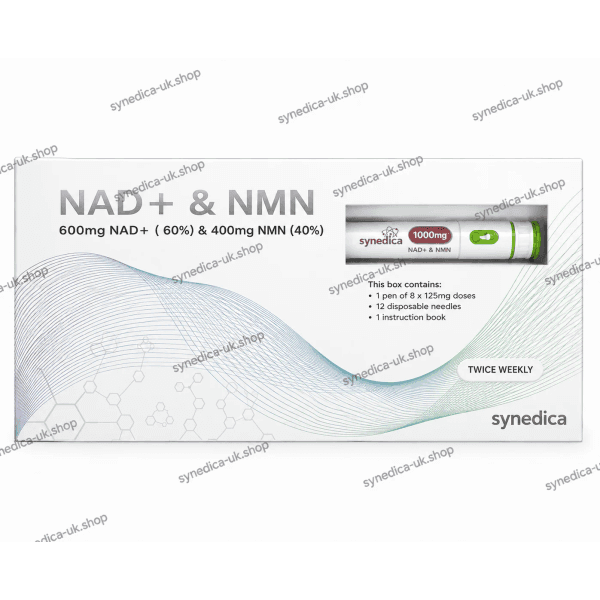
Synedica NAD+ & NMN 1000mg Injection Pen Kit
Synedica NAD+ & NMN 1000mg combines nicotinamide adenine dinucleotide (NAD+, CAS 53-84-9) with nicotinamide mononucleotide (NMN, CAS 1094-61-7), studied together in research relating to cellular energy metabolism and NAD+ biosynthesis pathways, supplied as a 1000mg injection pen kit strictly for laboratory and in-vitro research use. It is not the oral NMN sold elsewhere as a food supplement — in the UK, NMN as a food ingredient falls under Novel Food Regulation and remains under FSA assessment, which is a separate regulatory question from this injectable research-use listing.
£120.00
Size
Form: Injection Pen Kit
Quantity
Form: Injection Pen Kit
Pack Size: 1000mg
Storage & Handling
Storage (Lyophilized): Store at -20°C in a dry, desiccated environment. – After Reconstitution: Store reconstituted peptide at 2–8°C and use within 30 days. For long-term storage, aliquot and freeze at -20°C. Avoid repeated freeze-thaw cycles. – Reconstitution: Reconstitute in sterile bacteriostatic water or appropriate buffer depending on experimental needs.
â ï¸ This product is sold strictly for in vitro research and laboratory use only. It is not for human or veterinary use. By purchasing or using this product, the buyer agrees they have read, understood and accept the Terms & Conditions of Synedica UK. Terms & Conditions.
NAD+ and NMN are widely marketed online in two very different contexts: as oral longevity supplements in some markets, and as injectable research compounds. These are not interchangeable, and the regulatory questions differ for each. Synedica NAD+ & NMN 1000mg Injection Pen Kit is supplied strictly as a research-use compound — it is not an oral supplement, and it is not sold or marketed as one. This page sets out the chemistry of both compounds, what published research has found, and how UK regulation of NMN as a food ingredient differs from the unlicensed-medicine basis on which this injectable research product is sold.
What NAD+ and NMN Are
NAD+ (nicotinamide adenine dinucleotide, oxidised form) is a coenzyme central to cellular redox reactions and is consumed as a substrate by sirtuins (SIRT1–7) and PARP enzymes. It carries CAS number 53-84-9, molecular formula C21H27N7O14P2, and a molecular weight of approximately 663.4 g/mol. NAD+ should not be confused with NADH, its reduced form — a distinct compound with CAS number 606-68-8 — or with various salt forms, each of which carries its own CAS number.
NMN (nicotinamide mononucleotide) is a direct biosynthetic precursor to NAD+, converted via NMNAT enzymes (NMNAT1–3) in the NAD+ salvage pathway. It carries CAS number 1094-61-7, molecular formula C11H15N2O8P, and a molecular weight of approximately 334.2 g/mol. Because NMN sits one enzymatic step upstream of NAD+, the two compounds are frequently studied together in NAD+-metabolism research.
What Current Research Says
A 2021 review (Covarrubias, Perrone, Grozio and Verdin, Nature Reviews Molecular Cell Biology) summarised NAD+ metabolism and its role in cellular processes during ageing, describing the biosynthesis pathways connecting NMN to NAD+ and the sirtuin/PARP pathways NAD+ supports. Separately, human clinical research on oral NMN has begun to appear: a 2022 randomised trial (Okabe, Yaku, Uchida et al., Frontiers in Nutrition) reported that 250mg/day oral NMN for 12 weeks was well tolerated and increased blood NAD+ levels in healthy adults, and a separate multicentre trial (Yi, Maier, Tao et al., 2022, GeroScience) evaluated an oral NMN supplement in middle-aged and older adults.
These trials studied a specific oral NMN supplement administered at a defined daily dose under trial conditions — they are not a characterisation of this injectable research-use blend, which is not administered, dosed, or studied in the way those trial protocols specify.
Regulatory Status in the UK
Neither NAD+ nor NMN is a controlled drug under the Misuse of Drugs Act 1971. As an injectable research-use blend, this listing sits in the same regulatory category as Synedica's other peptides: an unlicensed product under the Human Medicines Regulations 2012 (SI 2012/1916), not assessed by the MHRA, supplied strictly for laboratory and in-vitro research.
NMN specifically has a separate regulatory question in other contexts: as an ingredient in oral food supplements, NMN falls under retained EU Novel Food Regulation 2015/2283 in the UK, and remains under Food Standards Agency assessment as a novel food ingredient. That question applies to NMN sold as an oral supplement — it is a different regulatory pathway from this listing, which is not sold, labelled, or supplied as a food product, oral supplement, or any human-consumption item.
Specifications
| Property | NAD+ | NMN |
|---|---|---|
| CAS number | 53-84-9 | 1094-61-7 |
| Molecular formula | C21H27N7O14P2 | C11H15N2O8P |
| Molecular weight | ≈ 663.4 g/mol | ≈ 334.2 g/mol |
| Role | Redox coenzyme; sirtuin/PARP substrate | Direct NAD+ biosynthesis precursor |
| UK legal / regulatory status | Not controlled drugs; this listing is an unlicensed research-use product under the Human Medicines Regulations 2012, not MHRA-approved, supplied strictly for laboratory research | |
Both CAS numbers and molecular formulas are independently verifiable against public chemical databases such as PubChem.
Purity, Batch Testing and Certificate of Analysis Standards
Every Synedica NAD+ & NMN 1000mg Injection Pen Kit unit offered for sale is supplied with third-party analytical documentation confirming the identity and purity of both NAD+ and NMN, the analytical method used (typically HPLC or mass spectrometry), the batch or lot number, and the issuing laboratory. Given how easily NAD+ can be confused with NADH or a salt-form variant in generic listings, confirming the exact CAS numbers on a batch's COA against 53-84-9 (NAD+) and 1094-61-7 (NMN) is worth doing before use. See our contact page to request a Certificate of Analysis for a specific batch.
Sourcing and Verification
Before ordering, check that a listing states research-use status clearly rather than presenting the product as an oral supplement or wellness product, that batch documentation is offered rather than promised only “on request,” and that each compound's identity (CAS number, molecular formula) is independently verifiable against a source such as PubChem. Synedica NAD+ & NMN 1000mg Injection Pen Kit is offered for sale on this basis, with documentation available per batch. Researchers examining other coenzyme and recovery-adjacent research compounds may also find the Synedica NAD+ & B12 Kit relevant, and the full catalogue is browsable on the research products page.
Frequently Asked Questions
What is the difference between NAD+ and NMN?
NAD+ is the coenzyme itself, consumed by sirtuins and PARP enzymes in cellular redox reactions. NMN is a direct biosynthetic precursor to NAD+, converted via NMNAT enzymes. The two are studied together because NMN sits one enzymatic step upstream of NAD+ in the biosynthesis pathway.
Is this the same as the NMN sold as an oral supplement?
No. This is an injectable research-use blend, not an oral supplement. In the UK, NMN as a food ingredient falls under Novel Food Regulation 2015/2283 and remains under Food Standards Agency assessment — that question applies to oral NMN products, not to this listing, which is not sold, labelled, or supplied as a food or supplement.
Is NAD+ or NMN legal in the UK?
Neither NAD+ nor NMN is a controlled drug under the Misuse of Drugs Act 1971. This listing is sold as an unlicensed research-use product under the Human Medicines Regulations 2012, strictly for laboratory and in-vitro research, not for human application, and has not been assessed by the MHRA for safety or efficacy under this listing.
Does NAD+ injection actually work?
This listing makes no claim about what NAD+ or NMN do when administered to a person. Published research on oral NMN supplementation (Okabe et al., 2022, Frontiers in Nutrition; Yi et al., 2022, GeroScience) describes findings for a specific oral supplement studied under trial conditions, not for this injectable research-use product.
What has clinical research found about NMN?
A 2022 randomised trial (Okabe, Yaku, Uchida et al., Frontiers in Nutrition) reported that 250mg/day oral NMN for 12 weeks was well tolerated and increased blood NAD+ levels in healthy adults. A 2021 review (Covarrubias et al., Nature Reviews Molecular Cell Biology) summarised NAD+ metabolism and its role in cellular processes during ageing. These describe research on the active compounds, not claims about this specific research-use listing.
Is NAD+ the same as NADH?
No. NAD+ (CAS 53-84-9) is the oxidised form; NADH (CAS 606-68-8) is the reduced form and is a distinct compound with its own CAS number and molecular formula. Listings that use the two names interchangeably are describing different chemical entities.
What does the Certificate of Analysis (COA) show for this product?
A COA confirms the identity and purity of both NAD+ and NMN, the analytical testing method used (typically HPLC or mass spectrometry), the batch or lot number, and the issuing laboratory.
How are the CAS numbers used to verify these compounds?
CAS 53-84-9 identifies NAD+ and CAS 1094-61-7 identifies NMN. Researchers can cross-check these numbers, along with each molecular formula, against an independent database such as PubChem to confirm chemical identity before use.
Does the injection pen kit format affect the research application?
The pen kit is a delivery/packaging format only. This listing makes no dosing, administration, or reconstitution recommendations; researchers determine their own protocols in line with their institution's research and safety governance.
How should this product be stored before use?
Store according to the conditions printed on the batch documentation and product label. Exact storage parameters and shelf life are batch-specific and confirmed on the accompanying documentation.
Can this product be used as a supplement or anti-ageing treatment?
No. It is sold strictly for laboratory and in-vitro research use. It is not a food supplement, cosmetic, or medicinal product, is not for human or veterinary use or application, is not licensed under the Human Medicines Regulations 2012, and has not been assessed by the MHRA or FSA for safety or efficacy under this listing.
Where can I buy NAD+ and NMN for research use?
It is available for sale directly from Synedica UK, supplied with batch documentation and third-party testing for verified UK research buyers.
Related Reading
Author: Synedica UK Science & QA Team
Last updated: 30 August 2026