Home / Shop / Synedica BPC 157 & TB 500
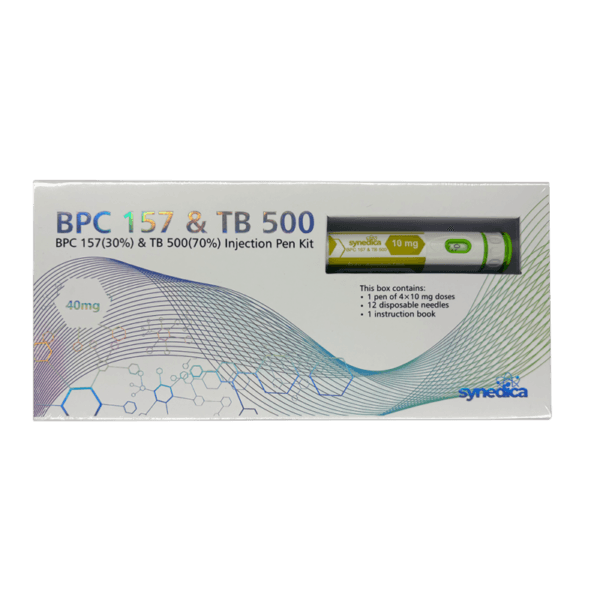
Synedica BPC 157 & TB 500
The Synedica BPC-157 & TB-500 Blend supplies BPC-157 (CAS 137525-51-0), a 15-amino-acid synthetic peptide, alongside TB-500 (CAS 885340-08-9), the synthetic N-acetylated 7-amino-acid fragment of thymosin beta-4, both studied in preclinical research into tissue repair and regeneration pathways. Synedica UK offers this blend for sale strictly for laboratory and in-vitro research use, not as a licensed medicine.
£120.00 – £21500.00
Kits
Size
Form: Injection Kit
Quantity
Blend: BPC-157 + TB-500
Form: Injection Kit
Storage & Handling
Storage (Lyophilized): Store at -20°C in a dry, desiccated environment. – After Reconstitution: Store reconstituted peptide at 2–8°C and use within 30 days. For long-term storage, aliquot and freeze at -20°C. Avoid repeated freeze-thaw cycles. – Reconstitution: Reconstitute in sterile bacteriostatic water or appropriate buffer depending on experimental needs.
â ï¸ This product is sold strictly for in vitro research and laboratory use only. It is not for human or veterinary use. By purchasing or using this product, the buyer agrees they have read, understood and accept the Terms & Conditions of Synedica UK. Terms & Conditions.
BPC-157 and TB-500 are two of the most searched research peptides in the UK, and listings for the blend are often thin on chemical detail — a purity percentage next to a photo, with little explanation of what each molecule actually is or what has been studied. One common inaccuracy is worth flagging up front: commercially sold "TB-500" is not the full thymosin beta-4 protein, but a much smaller synthetic fragment of it — a distinction several listings blur. This page sets out what the Synedica BPC-157 & TB-500 Blend actually is, what current research has found for each peptide, and how to verify what arrives before it goes anywhere near the bench.
What BPC-157 and TB-500 Are
BPC-157 ("Body Protection Compound-157") is a synthetic 15-amino-acid peptide, sequence Gly-Glu-Pro-Pro-Pro-Gly-Lys-Pro-Ala-Asp-Asp-Ala-Gly-Leu-Val, derived from a partial sequence identified in human gastric juice. It carries CAS number 137525-51-0, molecular formula C62H98N16O22, and a molecular weight of approximately 1,419.5 g/mol. Preclinical research has examined it for cytoprotective, angiogenic and anti-inflammatory activity in tissue-repair models.
TB-500 is a synthetic heptapeptide — Ac-Leu-Lys-Lys-Thr-Glu-Thr-Gln, written Ac-LKKTETQ — corresponding to the N-acetylated active fragment at residues 17–23 of thymosin beta-4 (Tβ4), a naturally occurring 43-amino-acid actin-binding protein. TB-500 is not the full Tβ4 protein; it is a much smaller synthetic fragment engineered to isolate the region associated with actin sequestration and cell migration. It carries CAS number 885340-08-9, molecular formula C38H68N10O14, and a molecular weight of approximately 889.0 g/mol. The two peptides are chemically and structurally distinct — a gastric-derived 15-mer and a thymosin-derived 7-mer fragment — studied together because both are examined in overlapping tissue-repair and regeneration research.
What Current Research Says
A 2025 systematic review in HSS Journal by Vasireddi and colleagues examined 36 studies on BPC-157 published between 1993 and 2024 (35 preclinical, one clinical). It reported that BPC-157 "enhances growth hormone receptor expression and several pathways involved in cell growth and angiogenesis, while reducing inflammatory cytokines" in preclinical models, that the compound is "metabolized in the liver, with a half-life of less than 30 minutes," and that preclinical toxicity testing found no adverse effects across tested doses. The single identified human study — 12 patients receiving intra-articular knee injections for chronic pain, not a Synedica UK product — reported that 7 of 12 patients had relief lasting over 6 months, but the review's authors stated plainly that "no clinical safety data were found" and that "clinical safety in humans remains unknown" (Vasireddi et al., 2025, HSS J).
A separate 2025 pilot study published in Alternative Therapies in Health and Medicine examined intravenous BPC-157 infusion in humans and reported it "was tolerated with no reported side effects" (Lee & Burgess, 2025, Altern Ther Health Med), though this remains a small early-phase safety pilot, not an efficacy trial.
For TB-500, a 2026 scoping review in Applied Sciences by McGuire and colleagues screened 1,772 records down to 80 included studies on thymosin beta-4 and TB-500 in tissue healing. It found the evidence base "skews toward preclinical work," that most studies examined native Tβ4 rather than the TB-500 fragment specifically, with "direct TB-500 evidence limited to a single included study," and that there were "no human interventional studies of administered TB4 or TB-500" for tendon, ligament, muscle, bone or cartilage applications (McGuire et al., 2026, Appl Sci). None of these findings constitute a treatment claim for this research-use product; they describe what has been studied in registered trials, pilot safety studies and preclinical literature on the two molecules, not what a laboratory-use compound sold by Synedica UK does for an individual.
Specifications
| Property | BPC-157 | TB-500 |
|---|---|---|
| Origin | Synthetic, based on a partial sequence from human gastric juice protein | Synthetic fragment (residues 17–23) of thymosin beta-4 |
| Sequence length | 15 amino acids | 7 amino acids (Ac-LKKTETQ) |
| CAS number | 137525-51-0 | 885340-08-9 |
| Molecular formula | C62H98N16O22 | C38H68N10O14 |
| Molecular weight | ≈1,419.5 g/mol | ≈889.0 g/mol |
| UK legal / regulatory status | Not licensed as a medicine under the Human Medicines Regulations 2012 as sold here; both peptides are prohibited in-competition by the World Anti-Doping Agency (WADA) — supplied strictly for laboratory research | |
Both sets of figures are independently verifiable against public chemical databases such as PubChem, and researchers are encouraged to cross-check batch-specific documentation against these reference values rather than relying on a listing description alone.
Purity, Batch Testing and Certificate of Analysis Standards
Every Synedica BPC-157 & TB-500 Blend offered for sale is supplied with third-party analytical documentation rather than a single purity percentage repeated across listings. A Certificate of Analysis (COA) should show the specific batch or lot number, the analytical method used (typically HPLC or mass spectrometry), the measured purity result for that batch, and the issuing laboratory. Given how many UK listings for this blend quote a purity figure without offering batch-specific evidence, and how often "TB-500" is described inaccurately as the full thymosin beta-4 protein rather than the smaller synthetic fragment, researchers should treat vague chemical descriptions and COA-on-request-only listings as a red flag rather than an oversight. See our contact page to request a Certificate of Analysis for a specific batch.
Sourcing and Verification
Buying a high-demand blend like BPC-157 and TB-500 from a UK-based supplier does not remove the need to verify what arrives. Before ordering, check that the listing states research-use status clearly, that batch documentation is offered rather than promised only "on request," and that each compound's identity (CAS number, molecular formula) is independently verifiable against a source such as PubChem. The Synedica BPC-157 & TB-500 Blend is offered for sale on this basis, with documentation available per batch. The full catalogue is browsable on the research products page.
Frequently Asked Questions
What is the Synedica BPC-157 & TB-500 Blend used for?
It supplies BPC-157 and TB-500 for laboratory and in-vitro research into tissue-repair and regeneration pathways, including angiogenesis, cell migration and inflammatory signalling. It is not sold for any therapeutic, dietary, or performance use.
Is TB-500 the same as thymosin beta-4?
No, and this is a common point of confusion. TB-500 is a synthetic 7-amino-acid fragment (Ac-LKKTETQ) corresponding to residues 17–23 of thymosin beta-4, a much larger 43-amino-acid protein. TB-500 is not the full protein — it is a smaller, synthetic piece of it, and the two should not be treated as interchangeable in research literature.
Is it legal to buy BPC-157 and TB-500 as research chemicals in the UK?
UK researchers and laboratories can lawfully purchase compounds such as BPC-157 and TB-500 when they are supplied and marketed strictly for research or in-vitro use rather than as a medicine. This product is not licensed under the Human Medicines Regulations 2012 (SI 2012/1916) and has not been assessed by the MHRA for human safety or efficacy under that route, so it must not be purchased for human or veterinary use. Both peptides are also prohibited in-competition under the World Anti-Doping Agency's banned substance list, which is relevant to athletes rather than laboratory researchers.
What does the Certificate of Analysis (COA) show?
A COA should confirm the batch number, the analytical testing method (typically HPLC or mass spectrometry), the measured purity for that specific batch, and the issuing laboratory, allowing a researcher to verify what a given batch actually contains rather than relying on a generic listing description.
How is the CAS number used to verify these compounds?
CAS 137525-51-0 identifies BPC-157 and CAS 885340-08-9 identifies TB-500. Researchers can cross-check these numbers, along with the molecular formulas (C62H98N16O22 for BPC-157; C38H68N10O14 for TB-500) and molecular weights, against an independent database such as PubChem to confirm chemical identity before use.
What has research found about BPC-157 so far?
A 2025 systematic review in HSS Journal examining 36 studies (35 preclinical, one clinical) found preclinical evidence for effects on cell growth, angiogenesis and inflammatory cytokine pathways, alongside a rapid hepatic half-life of under 30 minutes. The review's authors stated explicitly that no clinical safety data were found and that clinical safety in humans remains unknown. A separate 2025 pilot study reported intravenous infusion was tolerated with no reported side effects, but this was a small early safety pilot, not a treatment trial. Neither finding is a claim about this research-use product.
What has research found about TB-500 specifically?
A 2026 scoping review in Applied Sciences screening 1,772 records down to 80 included studies found that most thymosin-beta-4 research examines the native protein rather than the TB-500 fragment, with direct TB-500 evidence limited to a single included study, and no human interventional studies of either molecule for tendon, ligament, muscle, bone or cartilage applications. This describes a gap in the published literature, not a claim about this research-use product.
Why are BPC-157 and TB-500 studied together?
They are chemically distinct peptides — a 15-amino-acid gastric-derived sequence and a 7-amino-acid thymosin beta-4 fragment — but both are examined in overlapping preclinical tissue-repair and regeneration research, which is why researchers commonly study them alongside one another.
Does the product form (blend) affect the research application?
The blend format supplies both peptides together for convenience. This listing makes no dosing, administration, or reconstitution recommendations; researchers determine their own protocols in line with their institution's research and safety governance.
How should the Synedica BPC-157 & TB-500 Blend be stored before use?
Store according to the conditions printed on the batch documentation and product label, generally in cool, dry, dark conditions. Exact storage parameters and shelf life are batch-specific and confirmed on the accompanying documentation.
Can this product be used in human or veterinary applications?
No. It is sold strictly for laboratory and in-vitro research use. It is not a medicine, is not for human or veterinary use or consumption, is not licensed under the Human Medicines Regulations 2012, and has not been assessed by the MHRA for safety or efficacy under this listing.
Does Synedica UK ship the BPC-157 & TB-500 Blend within the UK?
Yes, this product is offered for UK delivery to research buyers.
Where can I buy the Synedica BPC-157 & TB-500 Blend for research use?
It is available for sale directly from Synedica UK, supplied with batch documentation and third-party testing for verified UK research buyers.
Related Reading
Author: Synedica UK Science & QA Team
Last updated: 29 August 2026