
Home / Shop / Biotin 40mg Injection Pen Kit | Laboratory Research
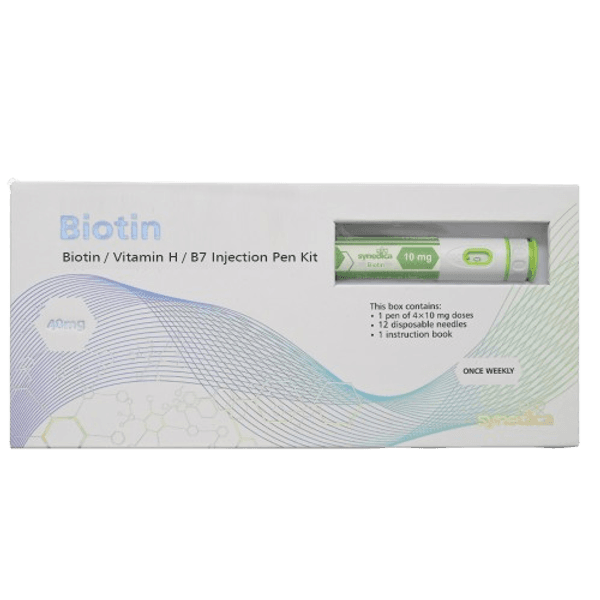
Biotin 40mg Injection Pen Kit | Laboratory Research
The Biotin 40mg Injection Pen Kit supplies D-biotin (vitamin B7, CAS 58-85-5), a water-soluble cofactor for five known human biotin-dependent carboxylase enzymes, studied in laboratory research into cellular metabolism and gene expression. Synedica UK offers this pen kit for sale strictly for laboratory and in-vitro research use, not as a licensed medicine.
£110.00 – £23500.00
Kits
Size
Form: Biotin Research Injection Pen Kit | Laboratory & In-Vitro Research Only
Quantity
Research Use: Strictly for laboratory and in-vitro research use.
Regulatory Status: Not a medicine, not for human or veterinary use or consumption, not licensed as a medicine under the Human Medicines Regulations 2012, and not assessed by the MHRA for safety or efficacy as a medicinal product.
Compound: Biotin
Common Names: Vitamin B7 / Vitamin H
CAS Number: 58-85-5
Molecular Formula: C10H16N2O3S
Molecular Weight: 244.31 g/mol
Pack Size: 40mg
Product Form: Injection Pen Kit
Research Context: Biotin-dependent carboxylases, biochemical metabolism, biotinylation and gene-expression research.
Scientific Reference: León-Del-Río, Journal of Inherited Metabolic Disease, published 19 March 2019. Biotin is described as a water-soluble vitamin and cofactor for biotin-dependent carboxylases.
Scientific Reference 2: Tong, Cell and Molecular Life Sciences, published March 2013. Biotin-dependent carboxylases are involved in fatty-acid, amino-acid and carbohydrate metabolism.
Chemical Verification: Biotin identity can be cross-checked using authoritative chemical databases including PubChem.
Purity: Refer to the applicable batch Certificate of Analysis. No generic purity percentage is substituted for batch-specific results.
Batch Testing: Refer to the applicable batch Certificate of Analysis and analytical documentation.
Storage: Follow the current product label and applicable batch documentation.
Shelf Life: Follow the applicable batch documentation.
COA: Batch-specific Certificate of Analysis should be reviewed against the material received.
UK Research Purchasing: UK research organisations should verify research-use status, documentation and applicable regulatory requirements before purchase.
Human Use: Not for human use, veterinary use or consumption.
Compliance Notice: This product is sold strictly for laboratory and in-vitro research use. It is not a medicine, is not for human or veterinary use or consumption, is not licensed as a medicine under the Human Medicines Regulations 2012, and has not been assessed by the MHRA for safety or efficacy.
Storage & Handling
Storage (Lyophilized): Store at -20°C in a dry, desiccated environment. – After Reconstitution: Store reconstituted peptide at 2–8°C and use within 30 days. For long-term storage, aliquot and freeze at -20°C. Avoid repeated freeze-thaw cycles. – Reconstitution: Reconstitute in sterile bacteriostatic water or appropriate buffer depending on experimental needs.
â ï¸ This product is sold strictly for in vitro research and laboratory use only. It is not for human or veterinary use. By purchasing or using this product, the buyer agrees they have read, understood and accept the Terms & Conditions of Synedica UK. Terms & Conditions.
Ask anyone who buys research compounds regularly in the UK and they'll tell you the actual bottleneck isn't finding a listing — it's finding one backed by a batch-specific Certificate of Analysis that actually matches what arrives. Underdosed or mislabelled batches, vendors who go quiet after payment, COAs that turn out to be recycled from a different lot: these are recurring frustrations reported across UK research forums, and they're exactly why sourcing verification matters as much as the molecule itself. This page sets out what the Biotin 40mg Injection Pen Kit is, what current research has established about biotin, and how to check what you're buying before it reaches the bench.
What Biotin Is
Biotin, also called vitamin B7 or vitamin H, is a small water-soluble organosulfur compound (molecular formula C10H16N2O3S) that functions as an essential cofactor for carboxylase enzymes. It was chemically characterised in the 1930s and has since become one of the most extensively studied coenzyme vitamins in biochemistry. In cells, biotin is covalently attached to carboxylase apoenzymes by the enzyme holocarboxylase synthetase, activating them for reactions central to fatty acid synthesis, amino acid catabolism, and gluconeogenesis.
How Biotin Is Used in Laboratory Research
Biotin is studied both as a metabolic cofactor in its own right and as a chemical handle — its extremely high affinity for streptavidin/avidin underpins biotin-streptavidin labelling systems widely used in molecular biology, immunoassays, and protein-purification workflows. The Biotin 40mg Injection Pen Kit is offered for sale for exactly this category of laboratory and in-vitro investigative work, not for any therapeutic application.
What Current Research Says
Biotin's core biochemistry is well established in the peer-reviewed literature, and research into its regulatory role continues. A 2019 review in the Journal of Inherited Metabolic Disease by León-Del-Río sets out biotin's function in metabolism and gene expression, describing how biotin availability itself feeds back to regulate transcription of biotin-dependent carboxylases and biotin transporters (León-Del-Río, 2019, J Inherit Metab Dis).
The clinical-genetics literature provides a useful reference point for how tightly biotin metabolism is studied at the population level: a September 2025 StatPearls review states that biotinidase deficiency — a disorder of biotin recycling — occurs in approximately 1 in 61,067 live births, and identifies five known human biotin-dependent carboxylases as the functional basis of biotin's role in metabolism (Cervantes & Daley, Biotin Deficiency, StatPearls/NCBI Bookshelf, updated 14 September 2025). That figure is drawn from inherited-disorder epidemiology, not from any claim about supplementation outcomes — it illustrates how well-characterised the biotin-carboxylase system is as a research subject, which is precisely why it remains a standard reference compound in metabolic and molecular biology laboratories.
Independent chemical identity data for biotin (CAS 58-85-5, molecular weight 244.31 g/mol) is publicly verifiable via PubChem (CID 171548), which researchers can cross-check against any batch-specific analytical documentation supplied with an order.
Purity and Certificate of Analysis Standards
Every batch offered for sale is supplied with third-party analytical documentation rather than a single generic purity figure repeated across listings. A Certificate of Analysis (COA) should show the specific batch or lot number, the analytical method used (typically HPLC), the measured purity result for that batch, and the testing laboratory. Researchers are encouraged to cross-reference the compound identity shown on the COA (CAS number, molecular formula) against an independent chemical database such as PubChem before use.
Sourcing and Verification
Buying research compounds from a UK-based supplier does not remove the need to verify what arrives. Before ordering, check that the listing states research-use status clearly, that batch documentation is offered rather than promised only "on request," and that the compound identity (CAS number, molecular formula) is independently verifiable. The Biotin 40mg Injection Pen Kit is offered for sale on this basis, with documentation available per batch rather than as a one-off marketing claim.
Frequently Asked Questions
What is the Biotin 40mg Injection Pen Kit used for?
It supplies D-biotin (vitamin B7) for laboratory and in-vitro research into biotin-dependent carboxylase activity, cellular metabolism, and biotin-streptavidin labelling applications. It is not sold for any therapeutic, dietary, or performance use.
Is it legal to buy biotin as a research chemical in the UK?
UK researchers and laboratories can lawfully purchase compounds such as biotin when they are supplied and marketed strictly for research or in-vitro use rather than as a medicine. This product is not licensed under the Human Medicines Regulations 2012 (SI 2012/1916) and is not assessed by the MHRA for human safety or efficacy, so it must not be purchased for human or veterinary use.
What does the Certificate of Analysis (COA) show?
A COA should confirm the batch number, the analytical testing method (typically HPLC), the measured purity for that specific batch, and the issuing laboratory. It allows a researcher to verify what a given batch actually contains rather than relying on a generic listing description.
How is the CAS number used to verify this compound?
CAS 58-85-5 identifies D-biotin specifically. Researchers can cross-check this number, the molecular formula (C10H16N2O3S), and molecular weight (244.31 g/mol) against an independent database such as PubChem (CID 171548) to confirm chemical identity before use.
Does the product form (injection pen kit) affect the research application?
The pen kit format is a delivery/packaging format only. This listing makes no dosing, administration, or reconstitution recommendations; researchers determine their own protocols in line with their institution's research and safety governance.
How should the Biotin 40mg Injection Pen Kit be stored before use?
Store according to the conditions printed on the batch documentation and product label, generally in cool, dry, dark conditions. Exact storage parameters and shelf life are batch-specific and confirmed on the accompanying documentation.
How does this differ from an MHRA-licensed medicine containing biotin?
An MHRA-licensed medicine has been formally assessed for safety, quality, and efficacy for a specific human therapeutic use and carries a marketing authorisation. This product has not undergone that assessment, carries no marketing authorisation, and is supplied strictly for laboratory and in-vitro research — it is not an alternative to any licensed medicine.
What is holocarboxylase synthetase and why is it relevant to biotin research?
Holocarboxylase synthetase is the enzyme that covalently attaches biotin to carboxylase apoenzymes, activating them. It is a frequently studied node in biotin metabolism research, including its role in feedback regulation of biotin-dependent gene expression (León-Del-Río, 2019).
Can this product be used in human or veterinary applications?
No. It is sold strictly for laboratory and in-vitro research use. It is not a medicine, is not for human or veterinary use or consumption, is not licensed under the Human Medicines Regulations 2012, and has not been assessed by the MHRA for safety or efficacy.
Does Synedica UK ship the Biotin 40mg Injection Pen Kit within the UK?
Yes, this product is offered for UK delivery to research buyers.
Where can I buy the Biotin 40mg Injection Pen Kit for research use?
It is available for sale directly from Synedica UK, supplied with batch documentation and third-party testing for verified UK research buyers.
Related Reading
Author: Synedica UK Science & QA Team
Last updated: 29 August 2026